REČ KUĆU GRADI (2026)
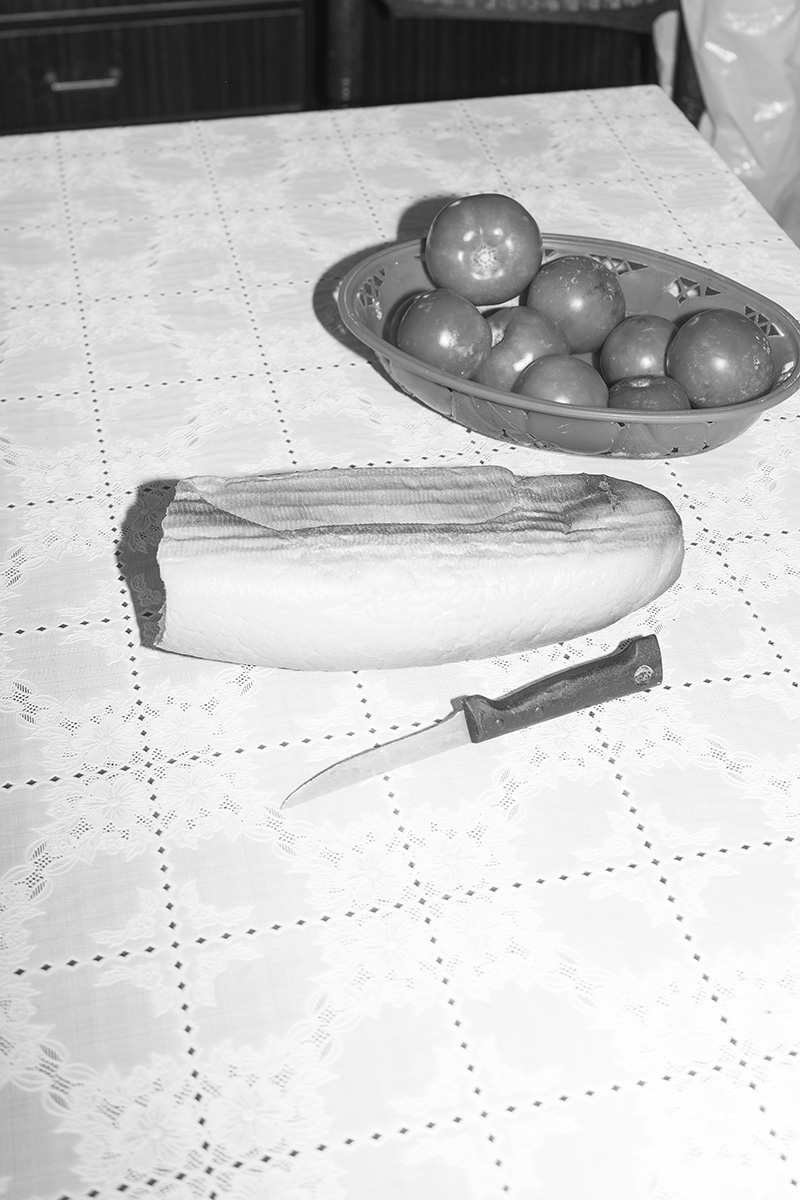
The work examines the family archive as a living and unstable structure, rather than as a fixed repository of memories. Objects that families use in everyday life, and that might never find their way into a memory box, subtly speak to how a family community is sustained through what is spoken, written down, preserved, but also left out within it.
Family memory does not appear as an immutable truth, but as a process of continuous editing through stories that are repeated, altered, and passed down across generations, as well as through those that are forgotten and omitted from the family narrative. In this process, the word is both a trace and a tool: it can preserve what has been, but it can also reshape what we remember.
The work also raises questions about the different forms of inheritance that shape a family narrative - what we inherit within the family and what we inherit as part of a broader culture. The textile installation, a curtain crocheted by my grandmother, my father’s mother, carries both of these forms of inheritance.
On an object that ordinarily establishes a boundary between the interior and the exterior, and that belongs to a specific family heritage, I intervene in the Serbian proverb: “Harmony builds a house, while discord tears it down.” The words harmony and discord are replaced with the same word - word - shifting the proverb away from its conventional meaning and opening it to a new reading: the word builds a house, and the word tears it down.

A scan of a family notebook (7x11cm) in which three generations have made entries over the years: my grandparents, my father and his sister, and my brothers, sister, and me. The notebook spontaneously became a family catch-all notebook, filled with recipes, telephone numbers, children’s drawings and games, and other notes. It functions as a small family archive that does not preserve major events, but rather fragments of everyday life recorded by different generations.

WORKS